

Last updated October 31, 2026
 Home additions & ADU
 Kitchen remodeling
 Bathroom remodeling
 Roofing
 Windows & doors
 Driveway & pavers
 Fence
Free written scope consultation - allowances, timeline, and change-order rules on paper before a single trade is scheduled
Construction Warning Signs: A Corona Homeowner’s Reference Guide
Most Corona homeowners are looking for the wrong warning signs. They scan for the dramatic – a cracked wall, a sagging roofline, a visible leak – and miss the quiet indicators that precede major failures by one to three years. A hairline crack in stucco along a window corner is not normal settling in Corona. It is a documented early indicator of clay soil movement or improper flashing installation, and distinguishing between the two requires a contractor who understands both trades. This guide teaches you to read your home the way an experienced Corona contractor reads it: from the caulk line to the grade slope to the attic temperature.
Quick Answer
Construction warning signs in Corona fall into three categories: structural movement indicators caused by expansive clay soil, moisture intrusion indicators tied to exterior system failures, and installation defects that mimic material failure. The subtle signs – hairline stucco cracks at window corners, paint bubbling on interior walls, baseboard gaps that widen in summer – appear one to three years before major failures and are routinely missed by homeowners who wait for visible damage. Learn to spot them now, and you can schedule a targeted repair or estimate before a cosmetic issue becomes a structural one.
Styles & brands we work with
Table of Contents
- Why Corona Soil Makes Stucco Cracks Different
- Interior Warning Signs That Point to Exterior Failures
- Roofing Warning Signs You Can Spot From Ground Level
- Installation Defects vs. Material Failure: How to Tell the Difference
- Severity Triage: When to Wait, When to Act
- Caulk Lines, Grading Slopes, and Attic Temperatures: The Indicators Competitors Miss
- Fencing and Hardscape Warning Signs in Corona’s Climate
- Common Mistakes to Avoid
- When to Call a Professional
- Frequently Asked Questions
Why Corona Soil Makes Stucco Cracks Different
Corona sits on expansive clay soil that swells when wet and shrinks when dry. This movement is not constant – it follows the region’s wet season and dry season, which means your home’s foundation experiences cyclical stress every single year. Homes built on this soil develop a specific pattern of warning signs that a contractor who only works in coastal Orange County might misread as ordinary settling.
Here is the pattern we see in Corona homes:
- Hairline cracks radiating from window corners and door headers at 45-degree angles. In coastal homes, this is usually cosmetic. In Corona, it often indicates differential movement between the wall framing and the stucco shell, driven by soil expansion beneath one section of the foundation.
- Stair-step cracks in masonry or stucco that follow mortar joints. This pattern tracks the path of least resistance through the wall system. When the soil under one corner of the home moves more than the soil under the center, the wall cracks along joint lines rather than through the face of the material.
- Cracks that open wider in winter and close slightly in summer. This is the strongest tell of expansive soil movement. If you can see seasonal variation in crack width, the issue is active, not historical.
What does a cosmetic crack look like in Corona? It is typically under 1/16 inch wide, vertical or near-vertical, and does not change with the seasons. What does a structural crack look like? It is wider than 1/8 inch, follows a diagonal or stair-step pattern, and grows over time. If a crack in your Corpus Corona neighborhood home is wide enough to slide a nickel into, schedule an assessment. If it is wide enough for a quarter, schedule it this week.
One note on framing: some newer Corona homes use steel framing, which moves differently than wood. Steel expands and contracts with temperature more than wood, which means a diagonal crack at a window corner in a steel-framed home can indicate thermal movement rather than soil movement. This distinction matters, because the fix is different. A contractor who specifies GAF roofing and James Hardie siding for exterior work will understand the difference between a stucco crack that needs a flexible sealant and one that needs foundation inspection. That difference separates a cosmetic repair from a structural one.
Interior Warning Signs That Point to Exterior Failures
Most homeowners treat interior wall cracks, bubbling paint, and tilted doors as signs of age. In Corona, they are usually signs of an exterior failure that has already started. The sequence is predictable: water gets past the building envelope, the framing or drywall absorbs it, and the interior finish reacts. By the time you see the interior symptom, the exterior breach has been active for months or years.
Here are the interior indicators we see most often in Corona homes, and the exterior failure each one points to:
- Paint bubbling or peeling on a ceiling or upper corner of a room. This almost always maps to a roof leak or a flashing failure at a roof-to-wall intersection. In Corona, the leak often starts small during a winter storm, dries out in the dry season, and repeats the next year. The paint bubble is the annual report card.
- A door that starts rubbing at the top corner or along the latch side. This is frequently misread as humidity. In Corona’s clay soil environment, a door that shifts seasonally may indicate foundation movement on one side of the door frame. Check the baseboard gap directly below the rubbing side – if it has widened over time, the floor system is moving.
- Baseboard gaps that open and close with the seasons. This is one of the most reliable early indicators of slab movement in Corona. The gap is the floor moving away from the wall, not the baseboard shrinking. If you can fit a dime in the gap during winter and a nickel during summer, the slab is actively moving.
- Mold staining on an exterior-facing wall, especially on the north side of the home. Corona’s dry climate suppresses mold growth in most conditions. When it appears on an exterior wall, it signals a persistent moisture source, usually a failed window seal, improper flashing, or a stucco crack on the corresponding exterior face.
- Windows that are harder to open or lock in the wet season. This is the building envelope responding to moisture expansion in the frame. It points to missing or deteriorated flashing above the window, which is a correctable installation issue rather than a material defect.
These symptoms rarely announce themselves as exterior failures. The homeowner notices the door rub, the paint bubble, the musty odor – and attributes each one to something else. When you see two or more of these symptoms in the same room or same wall line, the probability of an active envelope breach is high. A General Contractor in Anaheim sees the same pattern across the Inland Empire, and we see it in Corona weekly: interior symptoms are usually the last warning sign before a much larger failure shows itself.
Roofing Warning Signs You Can Spot From Ground Level
You do not need a ladder to identify most roofing warning signs in Corona. The city’s clear skies, dry air, and low humidity mean sunlight and heat are the primary roofing stressors – which means the warning signs tend to be visible from the street, the driveway, or the backyard. Here is what a trained contractor looks for from the ground.
- Granule loss visible as bare patches darker than surrounding shingles. Corona’s UV exposure breaks down the asphalt binder in shingles over time. Granule loss shows up as dark, glossy patches where the fiberglass mat is exposed. This is accelerated aging, and it means the shingle is past the midpoint of its useful life.
- Shingle edges that look curled or scalloped in direct afternoon heat. When you see this from the ground, the shingle has been heat-stressed for multiple summers. The edge curls upward, allowing wind and water to get under it during winter storms. Manufacturers like GAF, CertainTeed, and Owens Corning design their shingles to resist this, but even the best materials fail eventually in Corona’s inland heat.
- A subtle dip or valley in the roof line when viewed from the street corner. This is one of the most reliable ground-level indicators of decking failure or rafter deflection. The roof should read as a straight plane from the ridge to the eave. If it sags even one inch over a four-foot span, something beneath the shingles is failing.
- Buckling at flashing intersections, especially where the roof meets a chimney, skylight, or plumbing vent. Flashing failures are installation issues, not material failures. In Corona, the thermal cycling from hot days to cool nights expands and contracts the metal, breaking the sealant over time. A buckled or separated flashing is a matter of when water gets in, not if.
- Dark streaks or staining along the rake edge or in roof valleys. In Corona’s low-humidity climate, this is typically not moss or algae. It is more often a dust and dirt accumulation in areas where water flows slowly, indicating poor drainage or a low-slope section that needs attention.
These are all conditions a homeowner can observe from the sidewalk, the driveway, or the backyard. If you see two or more, schedule a professional roof inspection. A roofing contractor who works with GAF, CertainTeed, and Owens Corning products will be able to tell you whether the issue is material fatigue, installation error, or normal aging – and whether the fix is a repair, a partial replacement, or a full re-roof.
Installation Defects vs. Material Failure: How to Tell the Difference
When a system fails, homeowners often blame the product. But in our experience across Home Remodeling in Anaheim and Corona, most failures trace back to installation practices, not material defects. This distinction matters for one practical reason: installation defects are often covered by the contractor’s workmanship warranty, while material failures fall under the manufacturer’s product warranty. Knowing which one you are dealing with determines who you call and what you pay.
Signs of an Installation Defect
- The failure is localized to a specific transition point. Window flashing, roof-to-wall intersections, countertop seams, tile edges around a drain. Material failures tend to be widespread. Installation defects show up where one trade’s work meets another’s.
- The failure appeared within one to three years of installation. Products fail according to their wear cycles. Installation errors show up in the first few seasons, usually triggered by the first full thermal cycle or the first heavy rain season.
- The same failure pattern repeats in multiple locations on the same project. If three windows in the same room all leak at the same corner, the window is not the problem. The flashing detail is.
Signs of a Material Failure
- The failure is uniform across the entire installed area. Every shingle showing granule loss at the same rate, every plank of siding fading at the same rate, every tile cracking in the same pattern. That is the material aging, not the installer.
- The failure appears after the expected service life has elapsed. A roof that looks tired at 20 years is not a defect. It is a roof doing what roofs do in Corona’s climate.
- The material shows a manufacturing anomaly. Chalky residue on countertops, delamination in engineered flooring, seal failure on insulated glass units where the spacer is visibly misaligned. These are product issues, not labor issues.
Here is the practical takeaway for a Corona homeowner. If you are deciding between a warranty claim and a new project scope, look at where the failure is and when it appeared. A leak at a single window corner three years after installation is an installation issue. Faded siding across the full elevation after twelve years is material aging. When you work with a full-scope contractor – one who specifies the brand, manages the installation, and stands behind the result – the diagnostic path is clearer, because one team owns the entire sequence, as outlined in our General Contractor Maintenance Checklist for Corona Homeowners.
Severity Triage: When to Wait, When to Act
Not every warning sign requires a phone call this week. Some require observation, some require an assessment within 90 days, and some require immediate action. Here is a severity triage framework we use when evaluating Coronado homes – and the same framework applies across Riverside County.
Tier 1: Monitor and Recheck in 6 Months
- Hairline stucco cracks under 1/16 inch that do not appear to change.
- Slight paint fading on south-facing elevations.
- Minor caulk separation at bathtub or countertop edges.
- A door that rubs slightly only during the wettest month of the year.
These are routine conditions. Photograph them, mark the date, and recheck in six months. If they have not changed, continue monitoring. If they have changed, move to Tier 2.
Tier 2: Schedule an Assessment Within 90 Days
- Diagonal cracks next to window corners that have grown over the past year.
- Baseboard gaps that open and close seasonally, wider than a nickel at their widest.
- Ground-level roof indicators: granule loss patches, curled shingle edges, minor flashing separation.
- Paint bubbling on a ceiling that has been there through one dry season and one wet season.
- Doors that rub on the latch side, not just the top corner.
These indicate active, progressive movement or moisture intrusion. They will not heal themselves. A professional assessment now, before the failure expands, is the difference between a targeted repair and a full replacement.
Tier 3: Call a Contractor This Week
- A crack wide enough to slide a quarter into, especially if it is growing.
- Mold staining on an interior wall or ceiling.
- Roof sag visible from the street.
- Water staining that appears or expands during the first rainstorm of the season.
- A door that will not latch at all, or a window that has cracked glass from frame movement.
- Fencing that is leaning more than a few degrees, especially if it supports gate hardware.
These are active failures. Each day of delay expands the damage and the repair cost. When we see these conditions in Corona homes, the scope is rarely as simple as the homeowner expects – because the visible symptom is usually the endpoint of a sequence that started months earlier, which is why our General Contractor Troubleshooting: Common Problems and How to Fix Them starts with the earliest indicators.
Caulk Lines, Grading Slopes, and Attic Temperatures: The Indicators Competitors Miss
Most construction warning sign guides cover cracks, leaks, and sagging. They miss three subtle indicators that are specific to Corona’s climate and that routinely precede major failures by one to three years: caulk lines that fail in a particular pattern, grading slopes that have drifted from their original fall, and attic temperatures that reveal insulation or ventilation failures years before the inside of the home shows it.
Caulk Lines
Caulk is the weather seal at every transition point: window to stucco, door to frame, countertop to backsplash, tub to tile. In Corona’s climate, caulk endures extreme thermal cycling – daytime surface temperatures on a south-facing wall can exceed 160 degrees, then drop 70 degrees overnight. This cycle breaks the caulk’s bond over time. When you see caulk that has pulled away from one side but not the other, that side is moving. A gap that opens only on the bottom edge of a window frame means the weight of the window is bearing down on the seal. A gap that opens only on one vertical side means the wall is moving laterally. This is forensic information that a walk-around inspection can reveal before any larger failure appears.
Grading Slopes
Corona’s clay soil expands and contracts, but it also migrates. Rainwater moves topsoil downhill, and over years, a grade that once sloped away from the foundation can drift toward flat or even negative slope. The warning sign is subtle: after a rain, water pools against the foundation or forms a damp ring that lasts more than 24 hours. This is active water pressure against the foundation wall. In clay soil, that water is absorbed into the soil mass, which expands and presses against the wall. Over time, this produces horizontal cracks in foundation walls or shifting in the slab. Check your grade slope at least twice a year, once in the wet season and once in the dry. The fix – regrading or installing proper drainage – is inexpensive compared to foundation repair.
Attic Temperatures
Corona attics routinely reach 140 degrees in summer. When the attic temperature exceeds that by a wide margin – or when the temperature is uneven across the attic – the cause is usually inadequate ventilation, failed baffles, or compressed insulation. The warning sign appears on the ceiling below: paint cracking in a pattern that follows the ceiling joists, a room that is unbearably hot even with the AC running, or utility bills that have crept up year over year. The fix is rarely urgent, but it is time-sensitive. Every season of excessive attic heat ages the shingles from below and the framing from above, shortening the roof’s effective lifespan.
Fencing and Hardscape Warning Signs in Corona’s Climate
Fencing and hardscape are the most neglected warning sign categories in Corona, because they are read as aesthetic features rather than structural systems. But a fence that leans or a patio that shifts is broadcasting the same soil movement that is affecting your foundation, just at a smaller scale and an earlier stage.
Fencing
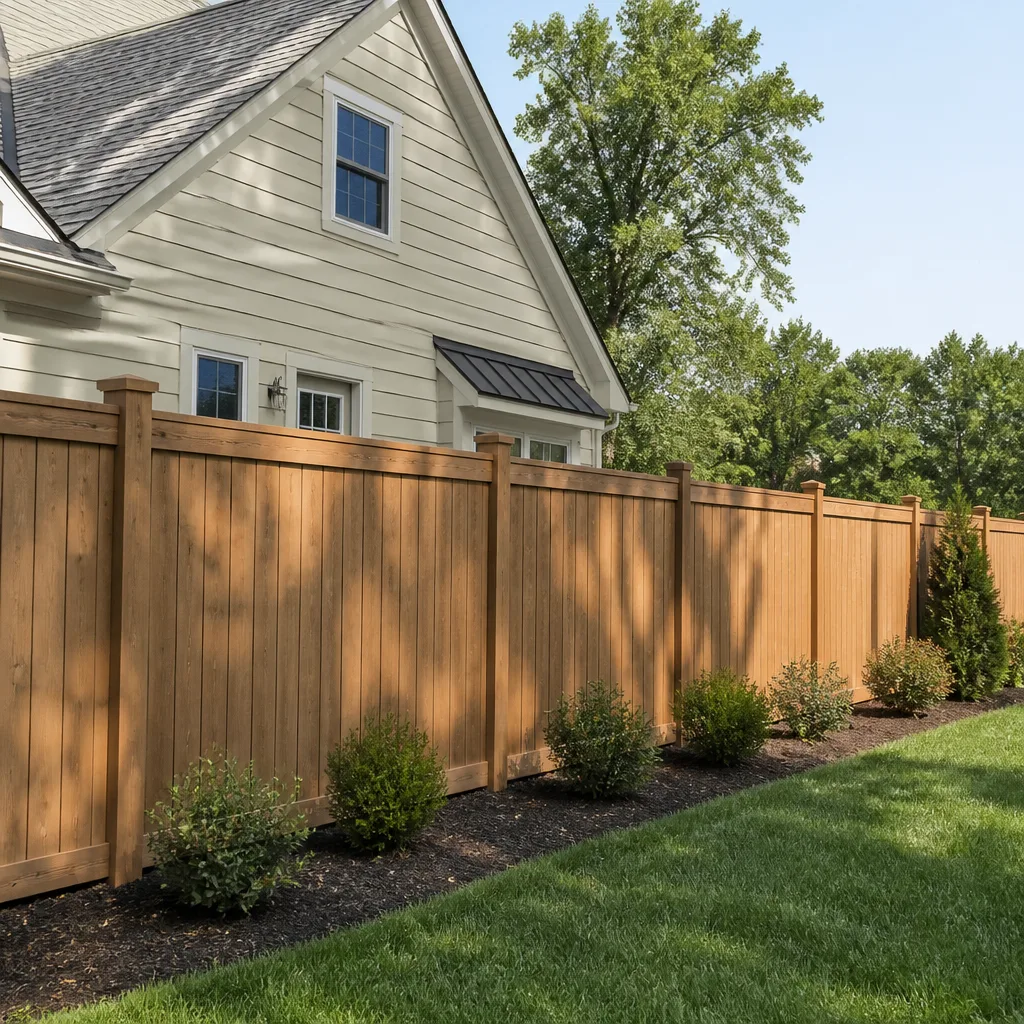
A fence post does not fail in isolation. It fails because the soil around it moved, eroded, or softened. If you see a fence post leaning, the soil condition that caused it is also acting on any structure nearby – including your home. Fence manufacturers like Master Halco and Jerith design their systems for specific soil conditions, but no manufactured fence can overcome active soil movement or poor drainage. Warning signs to watch for: posts that lean in wet months and partially recover in dry months, concrete footings that have cracked at ground level, and gate hardware that binds or misaligns seasonally. Each of these indicates soil movement that will eventually reach your foundation, your patio, or your retaining walls.
Hardscape
Corona patios, walkways, and retaining walls shift in predictable ways. The warning signs are small before they are large: a paver edge that has crept slightly away from the house, a hairline crack running along the mortar line of a retaining wall, a walkway slab that rocks underfoot. Amersitar and other fence manufacturers build for corrosion resistance, and hardscape manufacturers like Belgard and Unilock build for durability, but the underlying soil does not care about the material. When you see hardscape movement, assess the drainage and grade first, because the fix is almost always water management, not product replacement.
Common Mistakes to Avoid
- Ignoring a hairline crack because it looks cosmetic. In Corona’s clay soil, a crack at a 45-degree angle from a window corner is not cosmetic. It is movement. Photograph it, mark it, and recheck it every six months. If it grows, call a contractor.
- Treating interior symptoms as interior problems. Paint bubbling, baseboard gaps, and binding doors are almost always exterior failures showing up inside. Patching the drywall without fixing the roof or window flashing is repainting over a leak.
- Assuming one trade can solve a multi-trade problem. A foundation issue may require a general contractor to coordinate framing, drainage, and exterior finishing work. Calling three separate contractors for three separate pieces of the same problem creates coordination gaps and warranty disputes.
- Waiting until the failure is visible from across the street. A sagging roofline or a leaning retaining wall is not the beginning of the problem. It is the end. The beginning was a subtle grade change, a caulk failure, or a seasonal crack three years earlier.
- Patrolling for a single warning sign instead of reading them together. One crack is a data point. Two cracks plus a door rub plus a baseboard gap is a pattern. We read homes holistically, the way an experienced contractor does, and the pattern tells the story.
- Delaying the professional assessment until the project feels urgent. A contractor who can assess and schedule work on a flexible timeline will give you better pricing and better work than one responding to a crisis. The time to call is when the warning sign appears, not when the failure arrives.
When to Call a Professional
Call a professional when the warning signs move from static to progressive – meaning they have changed within the past year, or when you see two or more indicators in the same area of the home, a decision covered in our DIY vs Professional Construction: The Corona Homeowner’s Decision Guide. A diagonal crack at a window corner alone is worth monitoring. That same crack plus a door rub on the same wall is worth an assessment. A roof sag you can see from the street is worth a call this week. Trust your pattern recognition: when multiple small signs point to the same system, the system is talking.
If you are seeing warning signs and want a trained eye to assess them, Home Renovation in Anaheim is the type of work we handle across the Inland Empire, and we perform the same careful diagnostic walkthroughs in Corona. Gold Star Contractors offers free estimates in Corona. Call (833) 382-8544 to schedule your assessment – one contractor, every system, no handoff gaps.
Frequently Asked Questions
The most common warning signs in Corona are hairline stucco cracks at 45-degree angles from window and door corners, baseboard gaps that open and close seasonally, paint bubbling on ceilings, and ground-level roof indicators like granule loss and curled shingle edges. Most of these trace back to Corona’s expansive clay soil and thermal cycling.
A cosmetic crack is under 1/16 inch, vertical or near-vertical, and stable over time. A structural crack is wider than 1/8 inch, diagonal or stair-step, and grows between seasons. If it is wide enough for a quarter, schedule an assessment immediately. Call (833) 382-8544 for a free evaluation in Corona.
Worry when you can see sagging from the street, when granule loss is visible as dark patches from ground level, or when flashing has visibly separated at a chimney, skylight, or vent. These conditions mean water is already entering or about to enter during the next winter storm.
Yes. A full-scope general contractor manages interior remodeling, roofing, windows, fencing, hardscaping, and exterior systems through a single project team. That is the entire point of choosing one accountable contractor instead of coordinating Gold Star Contractors home separately across five different tradesmen.
Walk the perimeter twice a year – once in the wet season, once in the dry season – and check caulk lines, grade slopes, fence post alignment, and visible roof conditions. A ten-minute walk in January and July will catch most progressive failures before they become urgent.
A free estimate includes a walkthrough of the warning signs you have observed, a discussion of what is causing them, and a written scope of work with line-item pricing if a repair or remodel is needed. Estimates are free, and you are never obligated to proceed. Call (833) 382-8544 to schedule.
The Bottom Line
Corona homes speak a language of subtle warning signs – hairline cracks at 45-degree angles, baseboard gaps that breathe with the seasons, caulk lines that pull away on one side but not the other, attic heat that ages a roof from below. Learning to read these signs gives you a one-to-three-year head start on the fixes that would otherwise arrive as expensive, urgent failures. For more guides & resources on protecting your home, explore our blog. The pattern is the message: one crack is a data point, two cracks plus a door rub plus a paint bubble is a story. When you are ready to have that story read by a professional, one call handles every system. No handoff gaps, no coordination headaches, no finger-pointing between trades. Just a clear scope, the right materials, and one accountable team from start to finish.
Written by the team at Gold Star Contractors, serving Corona since 2012.
See the difference
 Before
 After
 Before
 After
 Before
 After